
Back to All Engineering Insights
Laboratory Diagnostics
Published 2026-08-24
•14 min read
Choosing the Right Clinical Laboratory Centrifuge in Kenya: Traditional vs. Modern Brushless Systems
Authored by Medwise Biomedical Advisory Team
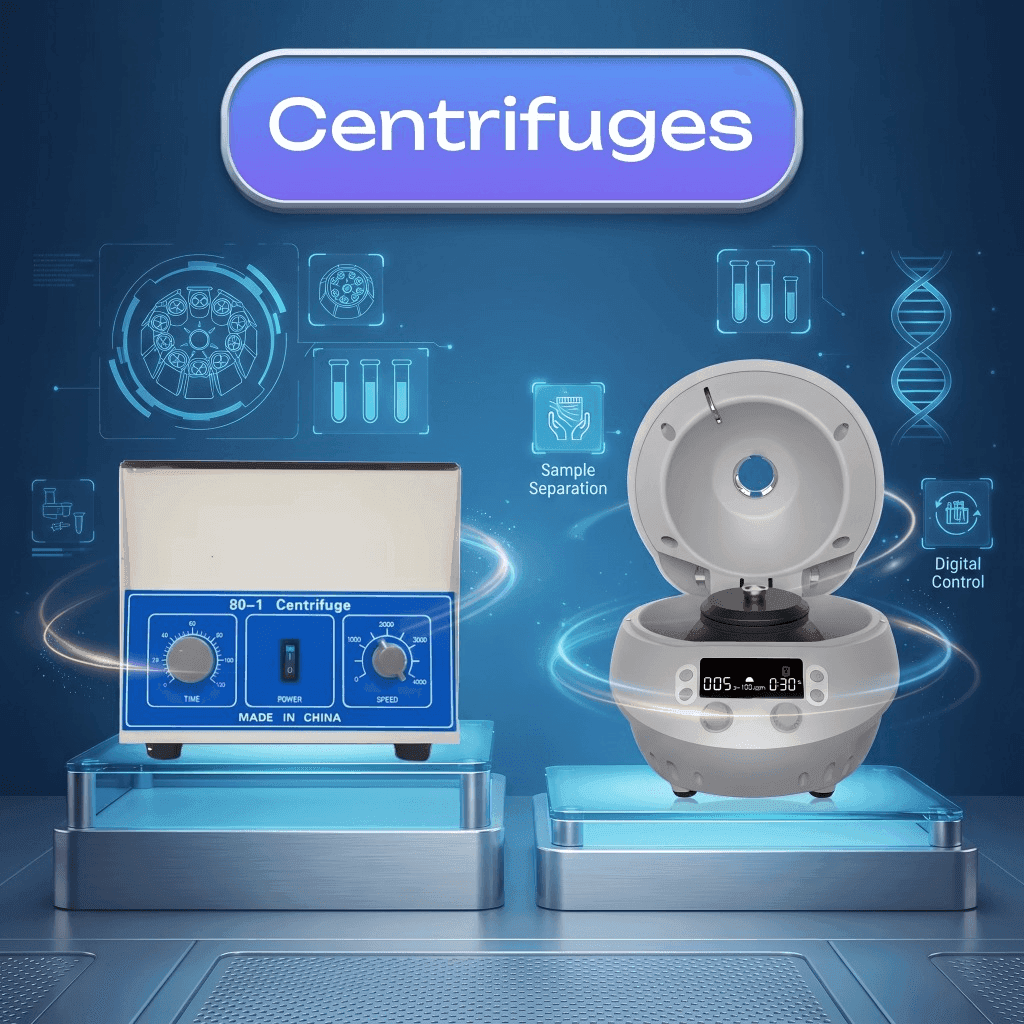
Technical Overview: Click image to expand high-resolution view
Are you setting up a new medical clinic, expanding an outpatient healthcare facility, or upgrading your diagnostic laboratory in Kenya? A reliable clinical laboratory centrifuge in Kenya is indispensable for separating whole blood components, preparing serum and plasma for biochemistry analyzers, and concentrating urinary sediments for microscopic examination.
However, investing in the wrong centrifuge model can lead to catastrophic pre-analytical diagnostic errors: hemolyzed blood specimens, shattered vacutainer collection tubes, excessive laboratory bench vibration, high operational noise, and frequent motor breakdowns [1, 2].
At Medwise Technical Consulting, our biomedical engineering team helps clinic owners, laboratory managers, and hospital administrators navigate equipment technical specifications to procure the most durable, safe, and cost-effective systems. Below is a comprehensive engineering breakdown of clinical centrifuges available in the Kenyan market today—comparing Traditional Entry-Level Models and Modern Brushless Digital Systems.
In medical laboratory diagnostics, over 70% of all laboratory testing errors occur during the pre-analytical phase—before the specimen is ever loaded into a biochemistry, immunoassay, or electrolyte analyzer [1].
Centrifugation represents the critical link between phlebotomy and analytical testing. When whole blood is spun at the proper Relative Centrifugal Force (g-force) and duration, the cellular components (erythrocytes, leukocytes, and platelets) separate cleanly from the liquid phase (serum or plasma).
| Separated Fraction Layer | Biological Constituents | Primary Clinical Diagnostic Target in Kenya |
|---|---|---|
| Top: Serum / Plasma Layer | Liquid fraction containing water, proteins, electrolytes, enzymes & hormones | Liver/Kidney chemistry panels, immunoassay serology & coagulation profiling |
| Middle: Buffy Coat Layer | Thin white interphase containing Leukocytes (WBCs) & Platelets | DNA extraction, specialized hematology differentials & blood banking cross-matches |
| Bottom: Gel Barrier / Packed RBCs | Thixotropic polyester polymer gel & concentrated Erythrocytes (RBCs) | Prevents cellular glycolysis and protects serum potassium (K+) from red cell leakage |
A common mistake among laboratory buyers in Kenya is evaluating centrifuges solely by Revolutions Per Minute (RPM). However, biological separation is driven by Relative Centrifugal Force (RCF), measured in gravities (g-force or g).
The actual force exerted on your sample depends on both the rotational speed and the radius (r) of the centrifuge rotor:
If a low-cost centrifuge has a small rotor radius, spinning at 4,000 RPM may generate insufficient g-force to cleanly activate the gel barrier in Serum Separator Tubes (SST), leading to incomplete barrier formation and sample contamination. Conversely, excessive uncalibrated acceleration causes mechanical shear stress that ruptures red blood cells (in-vitro hemolysis), falsely elevating potassium (K+), LDH, and AST test results.
Overview: These are the classic, economical desktop workhorses found in many upcoming health centers, dispensaries (zahanati), maternity homes, and small private laboratories across Kenya. They are straightforward, mechanical units engineered for standard routine spinning.
Traditional Centrifuge Mechanical Architecture
Drive Unit Carbon Brush AC Motor
Rotor Assembly Fixed-Angle 45° Rotor
Timing Mechanical Spring Timer
Enclosure Rubber Damped / Glass Lid
Perfect for small clinics, dispensaries (zahanati), and level-2 outpatient centers processing under 15 to 20 routine blood or urine chemistry samples per day on a tight startup budget.
Biomedical Advisory & Engineering StandardEstimated Price Range in Kenya: KES 15,000 – KES 35,000 (Standard 6-tube to 12-tube manual configuration).
Overview: If you run a medium-to-high throughput diagnostic facility, county referral hospital, busy maternity hospital, or reference laboratory, upgrading to a modern digital system equipped with a Brushless DC (BLDC) motor is a superior, long-term technical investment.
Modern Brushless (BLDC) Digital Architecture
Power System Brushless BLDC Motor
Logic Unit Microprocessor Control
Safety Protection Electronic Lid Interlock
User Interface Digital RPM / RCF LCD
Traditional centrifuges rely on carbon brushes that spark, generate thermal friction, and shed carbon particulates. Modern brushless centrifuges utilize electromagnetic induction coils to spin the rotor without physical brush contact [1, 2, 3].
Modern brushless centrifuges come standard with an electronic safety lid interlock and magnetic latch sensor [1, 2, 3]:
Ideal for Level 4/5 hospitals, high-volume private diagnostic hubs, commercial reference labs, and institutions requiring rigorous ISO 15189 compliance and zero downtime.
Biomedical Advisory & Engineering StandardEstimated Price Range in Kenya: KES 45,000 – KES 120,000+ (Depending on tube capacity [6, 8, 12, or 24 tubes], maximum speed capabilities [4,000 to 6,000+ RPM], and swing-out vs. fixed-angle rotor builds).
| Specification / Feature | Traditional Entry-Level Tier (Glass-Top / Round 6) | Modern Brushless Tier (Digital BLDC Systems) |
|---|---|---|
| Motor Architecture | Carbon Brush AC Motor (Requires routine brush replacement) | Maintenance-Free Brushless DC (BLDC) Motor |
| Lid Safety Mechanism | Manual mechanical latch / Glass inspection window | Electronic Safety Interlock + Dynamic Auto-Braking Sensor |
| Acoustic Noise Level | Moderate to High (65 – 75 dB with vibration) | Whisper Quiet (< 50 – 55 dB) |
| Thermal Chamber Heating | Noticeable chamber warmth from brush friction | Minimal ambient rise (Protects heat-labile analytes) |
| Speed & Force Control | Stepless Analog Knob (Approximate RPM) | Digital Microprocessor Control (Exact RPM & RCF g-force) |
| Tube Capacity Options | 6 x 15ml or 12 x 15ml Fixed Angle | 6, 8, 12, or 24 Tubes (with universal vacutainer adapters) |
| Imbalance Protection | None (Manual balancing mandatory) | Electronic Imbalance Gyroscope Cutoff Sensor |
| Daily Workload Capacity | 1 – 25 routine patient samples / day | 50 – 200+ heavy continuous samples / day |
| Estimated Price in Kenya | KES 15,000 – KES 35,000 | KES 45,000 – KES 120,000+ |
| Target Clinical Facilities | Dispensaries, Starter Clinics, Outpatient Centers, Schools | Level 4/5 Hospitals, Diagnostic Centers, Reference Labs |
Regardless of whether you choose a traditional entry-level unit or an advanced brushless system, improper rotor balancing is the #1 cause of motor bearing failure and benchtop accidents [2].
When loading sample tubes into your centrifuge rotor, every individual tube must be opposed by a tube of identical weight directly 180° across the rotor center:
Slots 1 & 4 (Directly Opposite Across Center)
Slots 1, 3 & 5 (Equilateral Triangle Geometry)
Slots 1, 2, 4 & 5 (Opposed Paired Sets)
To ensure optimal analytical results for clinical chemistry, serology, and urinalysis, follow standardized separation parameters:
| Sample / Tube Type | Target Specimen | Recommended Speed & Force | Spin Duration |
|---|---|---|---|
| SST (Yellow/Gold Top) / Plain Red Top | Serum for Clinical Chemistry & Hormones | 3,000 – 3,500 RPM (1,500 – 2,000 x g) | 10 – 15 Minutes |
| Sodium Citrate (Light Blue Top) | Platelet-Poor Plasma (PPP) for PT/INR & APTT | 3,000 – 3,500 RPM (1,500 x g) | 15 Minutes |
| Urine Conical Centrifuge Tube | Urinary Sediment for Microscopy (Casts/Crystals) | 1,500 – 2,000 RPM (400 – 500 x g) | 5 Minutes |
| Capillary Microhematocrit Tube | Packed Cell Volume (PCV / Hematocrit) | 11,000 – 12,000 RPM (14,000+ x g) | 5 Minutes |
RPM (Revolutions Per Minute) simply measures how many times the rotor turns per minute. RCF (Relative Centrifugal Force, measured in g-force or g) is the actual gravitational force exerted on the sample. RCF depends on both RPM and rotor radius. Diagnostic protocols require specific RCF to properly activate gel barriers and separate blood without causing hemolysis.
Brushless centrifuges eliminate carbon brushes, meaning zero carbon dust, whisper-quiet operation, minimal chamber heat buildup, and a significantly longer operating lifespan. They also feature electronic lid safety sensors that halt the motor immediately if the lid is opened, ensuring maximum staff safety.
In Kenya, traditional entry-level centrifuges (round 6-tube or compact glass-top models) range between KES 15,000 and KES 35,000. Modern digital brushless centrifuges range from KES 45,000 to KES 120,000+, depending on tube capacity (6, 8, 12, or 24 tubes) and digital features.
Under standard clinical guidelines (such as KMLTTB and ISO 15189 standards), a laboratory centrifuge should undergo digital optical tachometer speed verification, timer calibration, and electrical safety testing at least once every 12 months.
Don't risk your capital on unverified equipment that vibrates off your laboratory benches, overheats specimens, or shatters fragile vacutainer tubes. A quality centrifuge protects your pre-analytical sample phase, which directly guarantees accurate patient diagnostic results.
At Medwise Technical Consulting, our biomedical engineers assess your daily sample workload, facility tier, and budget to recommend the perfect balance of tube capacity, safety features, and motor longevity.
Medwise Technical Consulting provides brand-neutral equipment selection, procurement, installation, and precision calibration across Kenya. Speak directly with our practicing biomedical team today.

Independent advisory. Transparent flat-rate pricing. 100% clinical compliance.